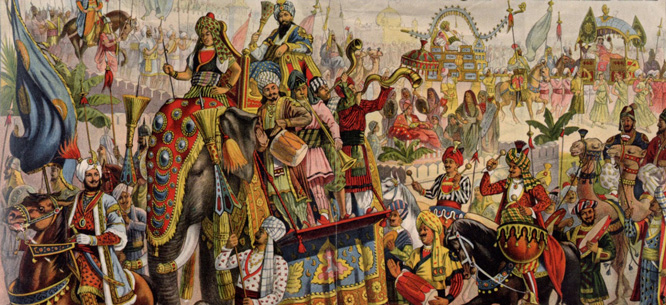
Orientalism is viewed as the interpretation of the Eastern world, be it in art history, literature, or cultural studies; such an interpretation has been set in place by artists and scholars from the West. This view tends to emphasize, exaggerate or even distort the image of Arabs and Arab culture, as it is construed by Western critics. Although it began ages ago, Orientalist views still delineate a lot of contemporary stances on the Middle East and Arab world, whether in plain sight, or emergent propensities that have been repressed. We see Orientalism in the way Westerner’s sing their songs, write their books, or simply speak of the Middle East.

Our team has decided to look into Orientalism as a work of intellectual history; we are curious to know why these views still hold true today, to a certain extent, and why they still affect the way the West (and the rest of the world), sees the East. In order to do so, we decided to analyze multiple relations regarding orientalist authors because we wanted to understand the meaning behind this topic and see how it affects us now and how it will affect us later.
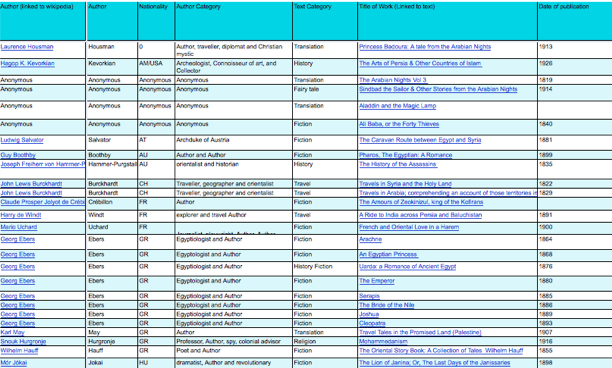
We started our project by creating a copy of the master spreadsheet that we used to analyze and interpret data; it is organized in a sense to include the author’s names, nationality, title of work, text category and date of publication. We used Palladio, since it is a great platform for this project and is typically used as a visual organizer. It allowed us to create different maps for different relationships, necessary for our data collection. Palladio helped us delve into the complex relationships between the information inserted in the different categories. It is important to keep in mind that our analysis from the networks are limited to the data we accessed from the master spreadsheet and we should not generalize on behalf of other uncollected data analysis.

The research questions we chose were:
- What major findings do we get when mapping the Orientalists?
- Is there a relation between the author’s nationality and text category?
- Which dates of publication are most dominant with each text category?
- Which text category emerges as the most representative in this group?
- Is there an obvious connection between the author’s nationality and category?
- What is the link found between the author’s category and text category?
- Is there a relation between the author’s nationality and date of publication?
- Is there a correlation between author’s nationality, text category, and author’s category?
After choosing our research questions, each team member researched different articles written about Orientalism. We each chose the ones that we found most interesting. The three diverse articles we chose were: “Orientalism: Past and Present” by Tobias Hübinette, “Orientalism: It’s Origins and Politics” by Nancy Demerdash, and “Orientalism: Then and Now” by Adam Shatz. Reading these articles enabled us to educate ourselves more about what Orientalism was really all about, and more importantly how it started and what role it plays in today’s world.
The analysis section of our project was the most time-consuming yet the most interesting part.
- Relation between the author’s nationality and the text category:
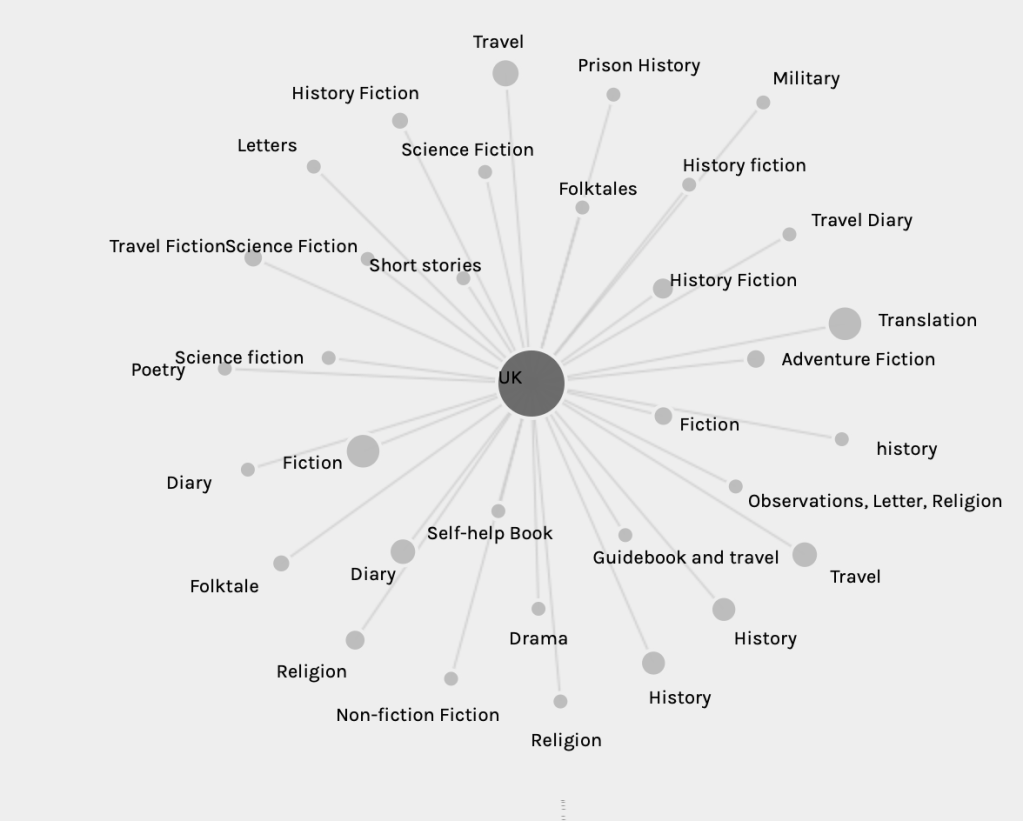
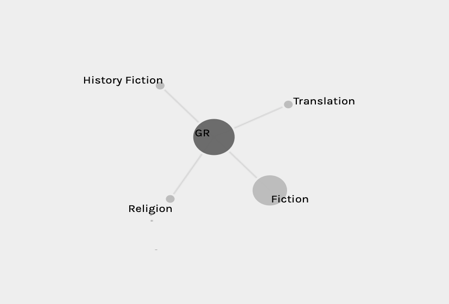
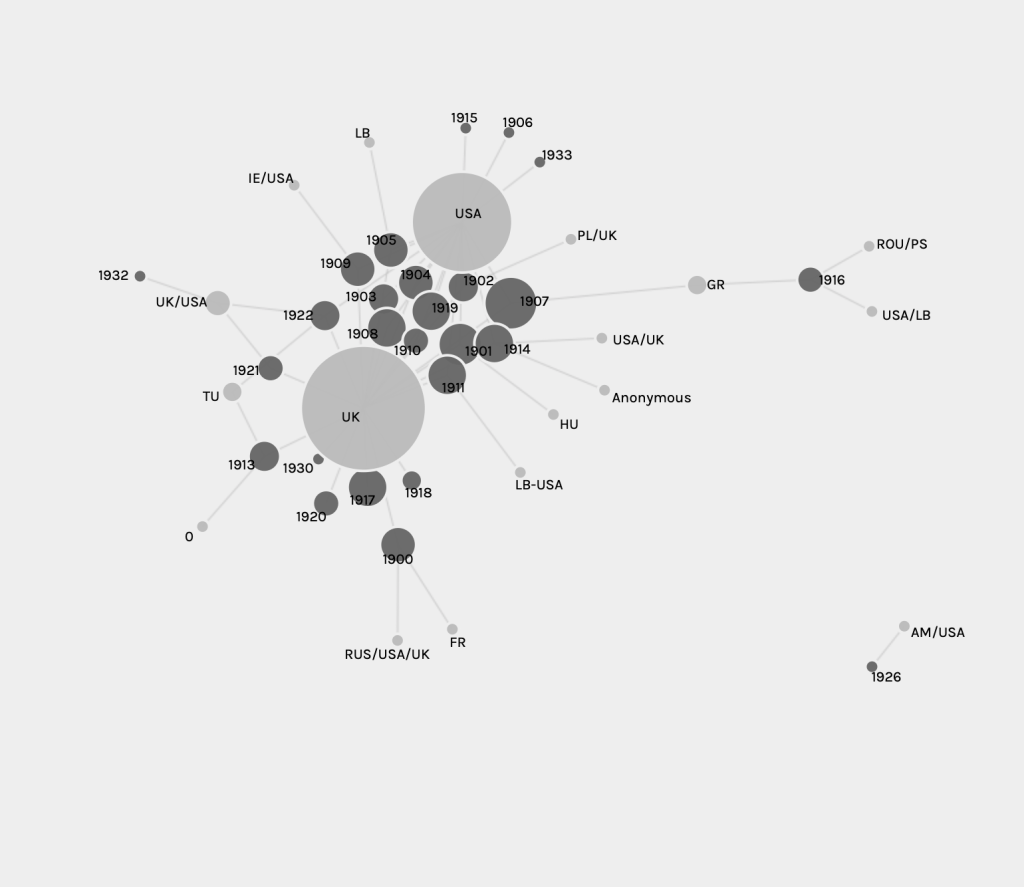
We noticed a few vital things that can help us in our research for the project. One being that the most dominant orientalist author nationality is British. The British authors mostly focused on writing fictional work, translation, and travel. They barely wrote about history, religion or the military. The American orientalist authors, on the other hand, mainly focused on fictional writings, and barely wrote about children literature, travel, or religion. We also observed that only three French orientalist authors are available in our data. Two of them focused on writing about fiction while the remaining authors wrote about travel.Another observation was that German orientalists mainly focused on writing fiction, and only a few authors wrote about religion or translation. Lastly, Multinational orientalists focused on writing both fiction and history fiction, they barely wrote about history or travel. Upon observing our networks with the help of Palladio, in the end of analyzing this research question, we saw that almost all orientalists wrote about fiction. Also, most of the authors are either British or American. To further elaborate on this, in the article “Orientalism: Past and Present” by Tobias Hübinette, the author mentioned that as long as Western countries remain dominant, the concept of Orientalism will always exist. As we previously observed in our data, the most frequent orientalist authors belonged to Western countries. Therefore, this shows us that orientalism is strongly embedded into the Western image to the extent that their power over the globe thrives off of it.

- Relation between the publication dates and text categories:
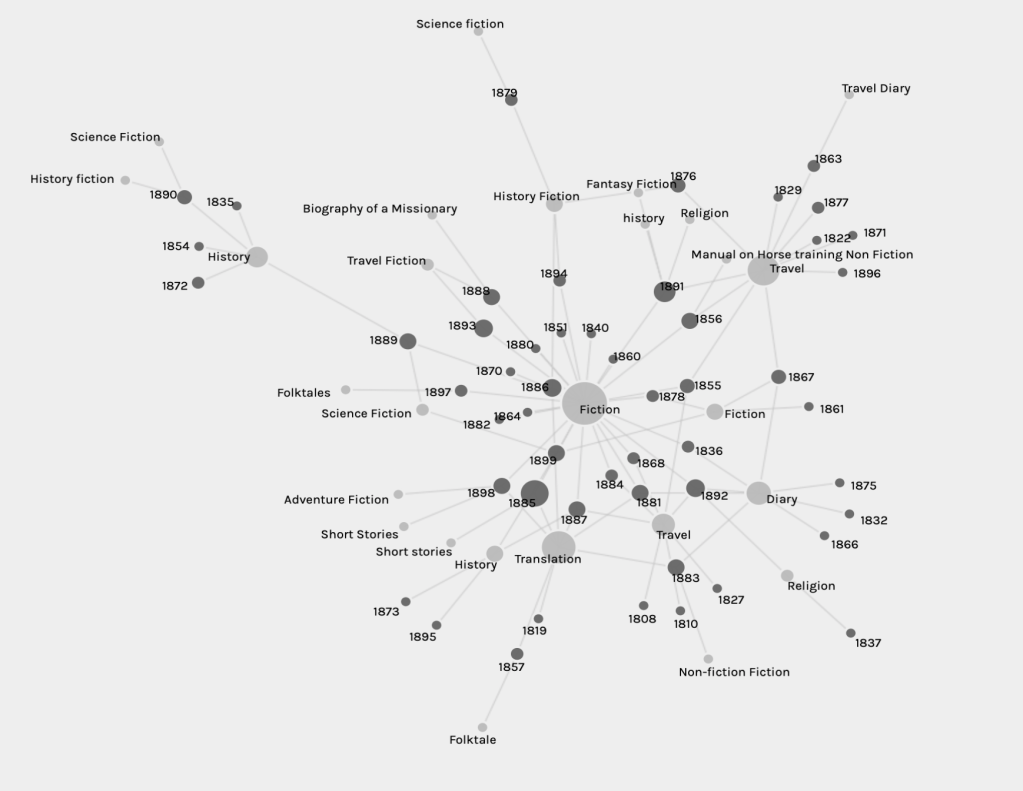
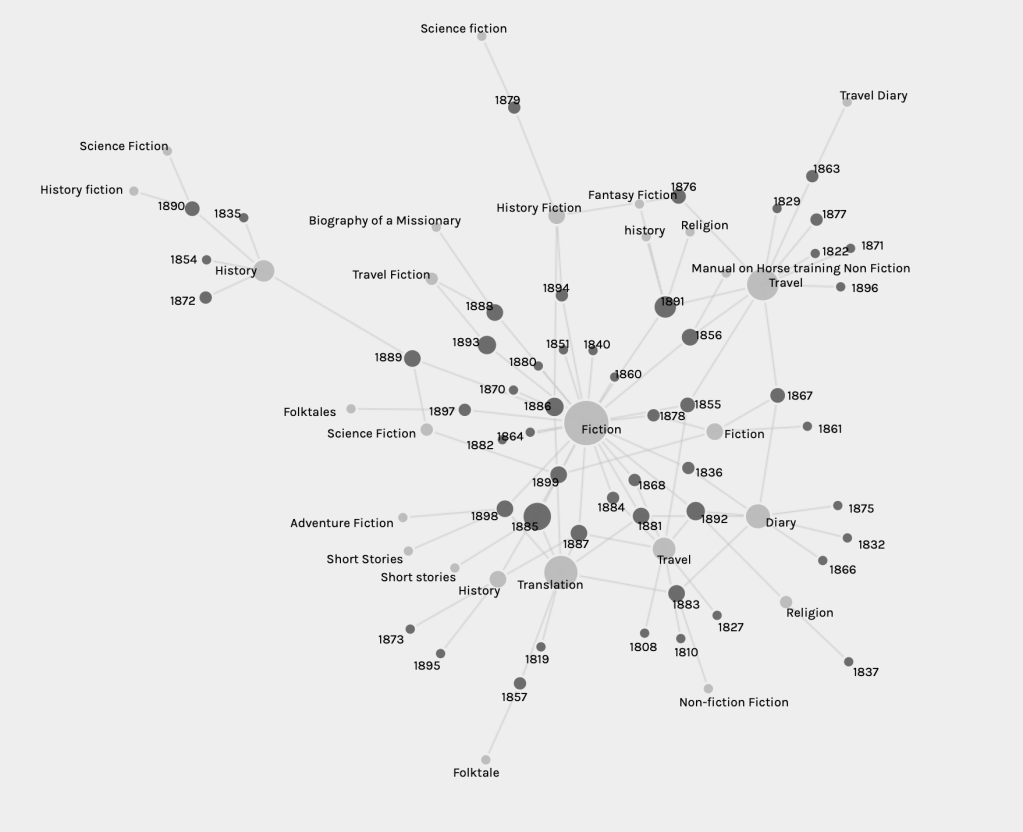
For this research question, we decided to group the different publication dates into centuries; in order to study the most and least frequent text categories written by orientalists over the years. During the 18thcentury, barely any orientalists published their work; however, those who did were very few.
Orientalist authors only wrote about fiction and travel during this century. Nevertheless, we saw that they flourished during the 19thcentury. Their work was mostly fictional; however, they also wrote about travel, translation, and history. The 20th century was a bit similar to the prior one. During the 20th century, Orientalist authors mainly focused on fictional writings, but they also wrote about travel, religion, history. In our current century, the 21st century, orientalism is still relevant; however, we noticed a significant drop in the work published during this century. With the help of our data, we were able to observe only two works related to history published in 2007 and in 2015. Therefore, not much orientalist work is being published at our time due to the evolution of the digital world; or we do not have enough data on the master spreadsheet in order to see if there are more works published that we haven’t collected information on; or we might actually find out that these writers are no longer called orientalists. We will never know unless we collect more data and analyze deeper, therefore we recommend that future semesters should work on developing the data on the master spreadsheet and focus on collecting more data on orientalist writers from our century.

- Relation between the publication dates and the author’s nationality:
During the 18th century, the predominant orientalist authors were mainly from the United Kingdom. Based on the data, there was no presence of any other nationality during this period. Whereas during the 19th century, the orientalist publications flourished. Many nationalities joined the United Kingdom, among them were authors from the United States and Germany. In addition, there were other nationalities that had a minor presence such as France, Syria and Lebanon. In the 20th century, the orientalists from the United Kingdom were still leading in terms of the author’s nationality. In addition, the number of the United States publications increased. Other nationalities like Russia, Hungary, Tunisia and Lebanon had a minor presence during this period. Unfortunately, in the century we live in, the number of publications has dropped significantly. With a presence limited to orientalists from the United Kingdom and Romania.

The most prevalent and difficult thing our team has faced during this project was the availability of data. When we first started discussing the topic of Orientalist authors and looking for relations to uncover, it felt like the spreadsheet in our hands was not the perfect source of information to rely on. As a team, we were capable of identifying very limited relationships between the authors and mapping them via Palladio; however, this wasn’t enough to come up with ideal analysis and conclusions.Therefore, we decided to look at different articles which cover the concept of Orientalism. With the help of these articles, we were able to look at the uncovered relations in a very coherent way, for we understood the meaning of Orientalism in-depth. Although not all the information we gained was relevant to the data we analyzed from the master spreadsheet, we still picked up on a few vital points that helped in our analysis. We have incorporated our articles in the analysis section where we saw fit to.

In conclusion, this project helped us become very familiar with the concept of Orientalism. We undercovered multiple hidden relations and noticed how the Orientalism remains with us even though it is not quite the same as the Orientalism discussed in the past. From the data provided, we noticed that it was limited in terms of geographical spread. The majority of the publications were from the UK, and little importance was given to other nationalities. On the other hand, all the data collected focuses mainly on orientalist publications from the 19th and 20th century. Furthermore, our team is going to give multiple suggestions so that students who will take this course in the future can use this as a point of reference and not be limited to a certain amount of data. This is why students should focus on finding additional data regarding a wider geographical scope. Also, students should work on looking for orientalist work published during different centuries and not just the 19th and 20th century. This means that they will be able to look at diverse results and analyze their findings properly. Students can even observe our current century and understand how the concept of Orientalism has evolved and how it remains valid up until today. All of these suggestions will make the students’ work much more reliable as they tend to cover all aspects of the topic related to Orientalist authors and their work.

This blog was written by Razan Muqattash, Lara El Hariri and Houssam Almaz Zounji.

We are a team of three students, at the American University of Beirut, who are driven by the passion of learning. Razan and Lara are Business Majors, while Houssam is a Civil Engineer. Working all together, we never expected to be a part of a team that got along so smoothly, it was like a puzzle put together. Each one of us had a talent that we projected onto this course & project, we each split the work evenly, and gave in our input whenever needed. This course has taught us about an entire world we didn’t know off, Orientalism, and we couldn’t have been more thankful of that because it taught us years of history. What we could all say we especially learnt from this project, besides Orientalism, was merely how to work so efficiently as a team, and how to bring our analytical skills to life. These are both extremely useful skills to have in our future courses and jobs.
References:
- https://www.dissentmagazine.org/wp-content/files_mf/142842028614283279971914_BarnumBailey_WizardPrincenohed666.jpg
- https://docs.google.com/spreadsheets/d/1p__8DcjRSm0yVNpY5t0STCtSENHWzLWp6zk-reyEYQI/edit#gid=0
- http://www.tobiashubinette.se/orientalism.pdf
- https://www.khanacademy.org/humanities/becoming-modern/introduction-becoming-modern/issues-in-19th-century-art/a/orientalism
- https://www.nybooks.com/daily/2019/05/20/orientalism-then-and-now/
- https://hdlab.stanford.edu/palladio-app/
- https://media.tenor.com/images/9417a4f73400757a7c38961507017728/tenor.gif
- https://media0.giphy.com/media/1oJRI1mXSDiDtX8QBv/200.gif
- https://www.aljazeera.net/file/GetImageCustom/be4e8ebe-eb1d-41d0-8e93-2f019521bbb2/1200/630



 Houssam's Blog